
Empires of the undergrowth моды
At this stage in the development cycle for the rest of Empires of the Undergrowth, we’re very close to having all of the creatures for the 4th tier complete (as well as a sizable chunk of the 5th tier ones). Our environment artist is working hard on perfecting the aesthetic of the Green Swamp, as the art team populates it with appropriate (and sometimes dangerous) flora.
 An infestation of harvestmen from TheRealStormCZE on our Discord [discord.com]
We’re ready to show off some of the underground look that the fire ants and their enemies will inhabit, as well as focusing on something that has, until now, evaded the Undergrowth entirely – vertebrates! The fire ant levels will feature a number of backbone owners, and we’ve been dying to show them off to you. We’ll also talk about the events we’ve been part of recently.
We showed off some early work on the underground look for the 4th tier last time, but we’ve now completed it, so let’s revisit!
 The eerie glow of the underground
A few months back we hired Dan C, who has taken to the role of environment artist with great enthusiasm. His vision for the Green Swamp was of an eerie, teal-lit underground, reminiscent of a glow worm cave.
 Fire ant workers come to clear the nest entrance
Inspired by various slime moulds that grow in damp conditions, he’s created this wonderful aesthetic which is quite different to anything that’s come before it, and adds some nice contrast to the bold redness of the fire ants themselves.
 The slime mould-inspired lamps and growths are generated for us by the engine as we work
Next time around we’re likely to have plenty to show for the surface too! We tend to show things off on Saturdays as part of Twitter’s Screenshot Saturday weekly hashtag, so remember to follow us on our socials to see stuff as soon as we post it.
The amphibians (the class Amphibia) are one of the five major classes of vertebrates. They’re widespread around the globe, and modern amphibians all exist in three orders – the frogs (Anura, 90% of amphibians), the salamanders (Urodela) and the caecilians (Apoda). We’re representing frogs and salamanders in Empires of the Undergrowth.
Coming into making this game, we were all beginners at nearly all aspects of game development. As we’ve continued the project all of us on the team have improved in the areas we’ve worked at. When we started all this, the idea of including the more complex considerations that go along with vertebrates (musculature, skin, more complex movements, etc) didn’t seem like something we wanted to touch on but that’s all changed. Let’s talk about some of the 4th tier’s amphibians.
The pine woods tree frog (Hyla femoralis) is a small frog that favours dark, damp conditions – making them ideal swamp dwellers. Despite their name, they are often found on the ground as well as in trees! They inflate their throats to make a distinctive, fast croaking sound (sound effects are a work in progress), especially at dusk. They’re fond of an insect supper, and ants are certainly on the menu.

The narrow-mouthed toad (Gastrophryne carolinensis) is native to much of the United States. Its diet consists primarily of ants – a trait that will make it one of your bitter enemies when the fire ant update comes for Empires of the Undergrowth, despite its cuteness! It is not technically a toad, but is colloquially called one because it is mostly terrestrial.
The dwarf salamander (Eurycea quadridigitata) represents the Urodela order, one of the three modern orders that make up the amphibians. It prefers swampy conditions and spends much of its time burrowed in the leaf litter. Its serpentine movements will be based on older code that was never finished for the cut velvet worm from the 3rd tier. This system allows it to bend its flexible spine as it travels, trailing its long body after it. There’s still some tweaks and adjustments to be made to the animation systems of this creature, but it’s far enough along to show you the main points.
So on to the biggest of them all! The American bullfrog (Lithobates catesbeianus) is widely spread around the world due to human introduction, but their native range is the eastern United States. Large, noisy and usually very hungry, bullfrogs are not fussy in their diet. In fact, generally speaking, the diet of the bullfrog consists of whatever will fit inside the bullfrog.
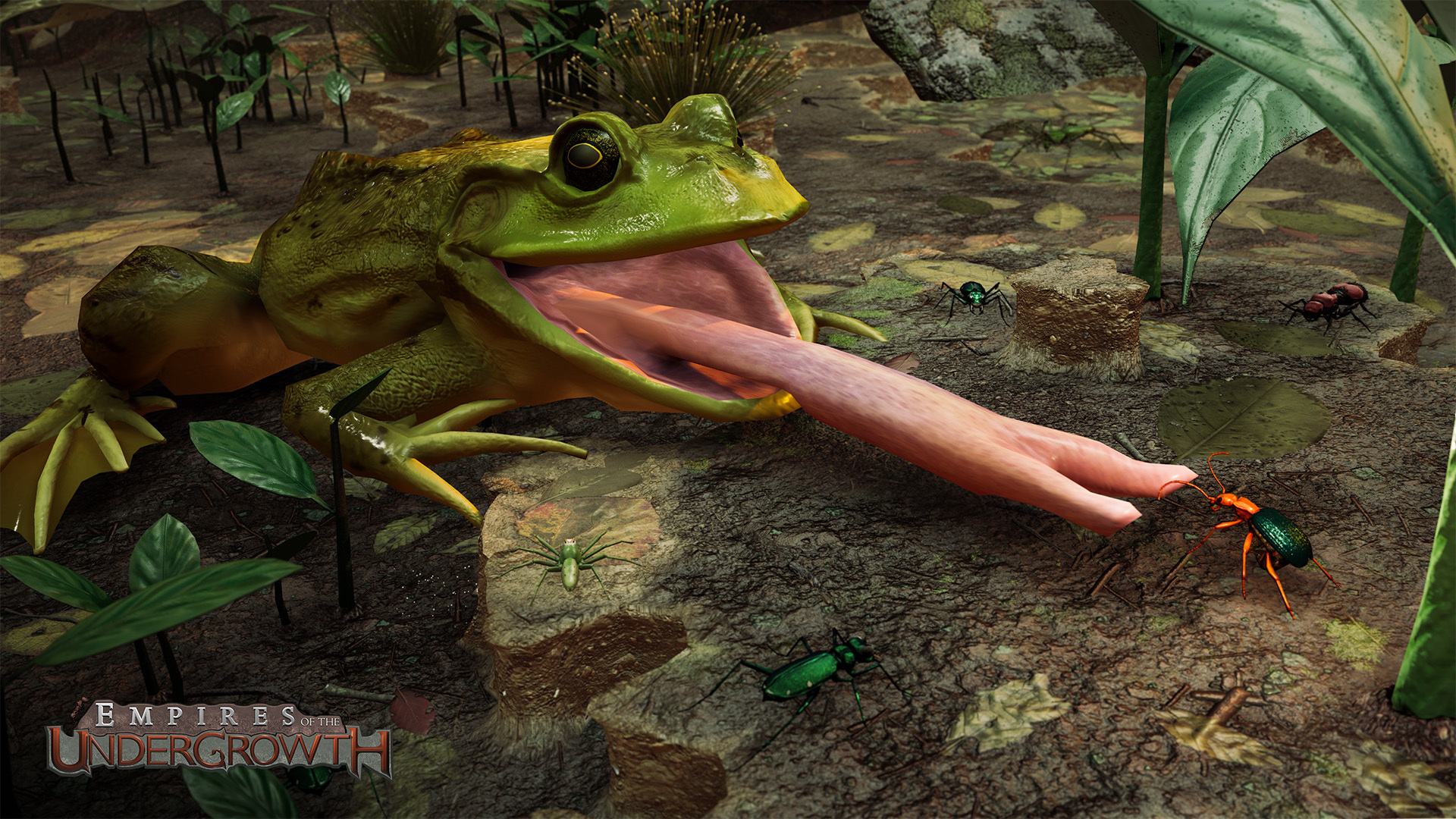 A bullfrog attacks a spicy snack (bombardier beetle)
Like the other frogs, the bullfrog is able to use its long tongue to grab and eat enemies at a considerable distance. As a titan, it can be climbed upon by swarming ants, dealing extra damage to vulnerable spots on its body. We won’t post any videos of this titan-class creature until closer to release. It’s on course to be the largest actual creature that will be in the game, if you don’t count the scientist (we don’t).
Three of us from the Slug Disco team (developer Liam, marketing content creator Dan and community manager Mike) will be joining our friend Paul Herve where we’ll have two booths at EGX, one showing Empires of the Undergrowth (a great opportunity to talk to us about the fire ant update!) and the other showing Paul’s awesome upcoming creature evolution game Adapt (more on this collaboration coming in the future). We’ll be in the EGX Rezzed Zone for all 4 days of the event (Thursday 7th October – Sunday 10th); come and find us if you’re in the area. We’re quite friendly.
 The last time they let us out in public – EGX 2019 along with Ecosystem & Beetle Uprising
 Our virtual booth in the Summercamp of Doom!
 We won!
 Our booth at BitSummit. One day, we’ll be there in person!
Something a little different for Screenshot Central this time – the three shots I’ve chosen all come from one player. Frazzz is a YouTuber and long-time coverer of Empires of the Undergrowth, and he recently played the aforementioned “The Promised Land” on his channel whilst it was an event. Thanks to him for sending in these excellent fire ant snaps – he’s really got an eye for them. We look forward to lots more Empires content from him!
Usually I take these screenshots either from our Discord [discord.com] or from the Steam community uploads; those are the easiest way for me to see them if you’d like to have your screenshot selected for a future newsletter.
 A fire ant hatches
 Fire ants link their bodies to create a short bridge to a nearby island
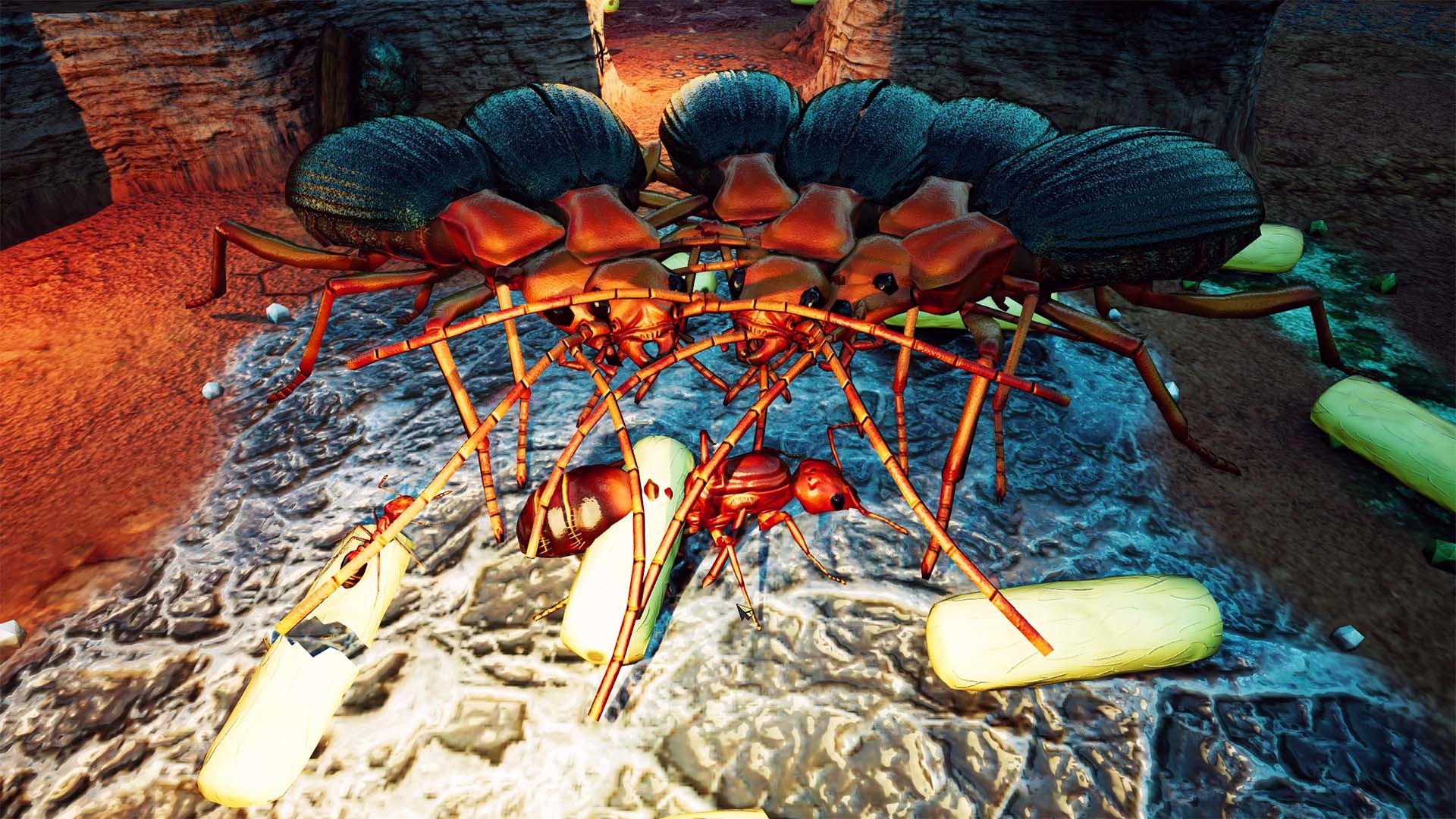 The queen is attacked by a group of bombardier beetles – the end is nigh
Empires of the Undergrowth
Slug Disco Studios | Early Access 2017
Empires of the Undergrowth is a simulation strategy game hybrid where you control an ant colony, excavating a nest underground and taking on large insects, arachnids and other colonies on the surface!

It’s Gamescom and we are here (digitally) as part of the Indie Arena Booth! To celebrate we are giving players the opportunity to try out fire ants for.
This demo includes 4 underground levels and a new level, The Crucible! Take control of the new leafcutter ants, gather leaves to raise a brood whilst.
THIS IS THE LINUX VERSION OF THE DEMO. This demo includes 4 underground levels and a new level, The Crucible! Take control of the new leafcutter ants.

EotU Win64 Underground Demo 0.064
Updates include improved trail mechanic, re-balanced levels and optimisations (more ants!). Windows 64-bit Empires of the Undergrowth is a simulation.
eotu win64 underground demo 0.064 demo
This demo includes 4 underground levels and a new level, The Crucible! Take control of the new leafcutter ants, gather leaves to raise a brood whilst.

EotU Win32 Underground Demo 0.064
Updates include improved trail mechanic, re-balanced levels and optimisations (more ants!). Windows 32-bit Empires of the Undergrowth is a simulation.
eotu win32 underground demo 0.064 demo
This version includes multiple updates, please see the version 0.05 video to see what has changed. New Level, new enemy, updated graphics, updated controls.
This version includes multiple updates, please see the version 0.05 video to see what has changed. New Level, new enemy, updated graphics, updated controls.
This version includes multiple updates, please see the version 0.05 video to see what has changed. New Level, new enemy, updated graphics, updated controls.
This version includes multiple updates, please see the version 0.05 video to see what has changed. New Level, new enemy, updated graphics, updated controls.
EotU Win64 Underground Demo 0.03 *OLD*
This version includes multiple updates, please see the version 0.03 video to see what have changed. Windows 64-bit Empires of the Undergrowth is a simulation.
eotu win64 underground demo 0.03 *old* demo
EotU Win32 Underground Demo 0.03 *OLD*
This version includes multiple updates, please see the version 0.03 video to see what have changed. Windows 32-bit Empires of the Undergrowth is a simulation.
eotu win32 underground demo 0.03 *old* demo
Windows 32-bit Empires of the Undergrowth is a simulation strategy game hybrid where you control an ant colony, excavating a nest underground and taking.
Windows 64-bit Empires of the Undergrowth is a simulation strategy game hybrid where you control an ant colony, excavating a nest underground and taking.
No files were found matching the criteria specified. We suggest you try the file list with no filter applied, to browse all available. Add file and help us achieve our mission of showcasing the best content from all developers. Join now to share your own content, we welcome creators and consumers alike and look forward to your comments.
Empires of the undergrowth моды
At this stage in the development cycle for the rest of Empires of the Undergrowth, we’re very close to having all of the creatures for the 4th tier complete (as well as a sizable chunk of the 5th tier ones). Our environment artist is working hard on perfecting the aesthetic of the Green Swamp, as the art team populates it with appropriate (and sometimes dangerous) flora.
An infestation of harvestmen from TheRealStormCZE on our Discord [discord.com]
We’re ready to show off some of the underground look that the fire ants and their enemies will inhabit, as well as focusing on something that has, until now, evaded the Undergrowth entirely – vertebrates! The fire ant levels will feature a number of backbone owners, and we’ve been dying to show them off to you. We’ll also talk about the events we’ve been part of recently.
We showed off some early work on the underground look for the 4th tier last time, but we’ve now completed it, so let’s revisit!
The eerie glow of the underground
A few months back we hired Dan C, who has taken to the role of environment artist with great enthusiasm. His vision for the Green Swamp was of an eerie, teal-lit underground, reminiscent of a glow worm cave.
Fire ant workers come to clear the nest entrance
Inspired by various slime moulds that grow in damp conditions, he’s created this wonderful aesthetic which is quite different to anything that’s come before it, and adds some nice contrast to the bold redness of the fire ants themselves.
The slime mould-inspired lamps and growths are generated for us by the engine as we work
Next time around we’re likely to have plenty to show for the surface too! We tend to show things off on Saturdays as part of Twitter’s Screenshot Saturday weekly hashtag, so remember to follow us on our socials to see stuff as soon as we post it.
The amphibians (the class Amphibia) are one of the five major classes of vertebrates. They’re widespread around the globe, and modern amphibians all exist in three orders – the frogs (Anura, 90% of amphibians), the salamanders (Urodela) and the caecilians (Apoda). We’re representing frogs and salamanders in Empires of the Undergrowth.
Coming into making this game, we were all beginners at nearly all aspects of game development. As we’ve continued the project all of us on the team have improved in the areas we’ve worked at. When we started all this, the idea of including the more complex considerations that go along with vertebrates (musculature, skin, more complex movements, etc) didn’t seem like something we wanted to touch on but that’s all changed. Let’s talk about some of the 4th tier’s amphibians.
The pine woods tree frog (Hyla femoralis) is a small frog that favours dark, damp conditions – making them ideal swamp dwellers. Despite their name, they are often found on the ground as well as in trees! They inflate their throats to make a distinctive, fast croaking sound (sound effects are a work in progress), especially at dusk. They’re fond of an insect supper, and ants are certainly on the menu.
The narrow-mouthed toad (Gastrophryne carolinensis) is native to much of the United States. Its diet consists primarily of ants – a trait that will make it one of your bitter enemies when the fire ant update comes for Empires of the Undergrowth, despite its cuteness! It is not technically a toad, but is colloquially called one because it is mostly terrestrial.
The dwarf salamander (Eurycea quadridigitata) represents the Urodela order, one of the three modern orders that make up the amphibians. It prefers swampy conditions and spends much of its time burrowed in the leaf litter. Its serpentine movements will be based on older code that was never finished for the cut velvet worm from the 3rd tier. This system allows it to bend its flexible spine as it travels, trailing its long body after it. There’s still some tweaks and adjustments to be made to the animation systems of this creature, but it’s far enough along to show you the main points.
So on to the biggest of them all! The American bullfrog (Lithobates catesbeianus) is widely spread around the world due to human introduction, but their native range is the eastern United States. Large, noisy and usually very hungry, bullfrogs are not fussy in their diet. In fact, generally speaking, the diet of the bullfrog consists of whatever will fit inside the bullfrog.
A bullfrog attacks a spicy snack (bombardier beetle)
Like the other frogs, the bullfrog is able to use its long tongue to grab and eat enemies at a considerable distance. As a titan, it can be climbed upon by swarming ants, dealing extra damage to vulnerable spots on its body. We won’t post any videos of this titan-class creature until closer to release. It’s on course to be the largest actual creature that will be in the game, if you don’t count the scientist (we don’t).
Three of us from the Slug Disco team (developer Liam, marketing content creator Dan and community manager Mike) will be joining our friend Paul Herve where we’ll have two booths at EGX, one showing Empires of the Undergrowth (a great opportunity to talk to us about the fire ant update!) and the other showing Paul’s awesome upcoming creature evolution game Adapt (more on this collaboration coming in the future). We’ll be in the EGX Rezzed Zone for all 4 days of the event (Thursday 7th October – Sunday 10th); come and find us if you’re in the area. We’re quite friendly.
The last time they let us out in public – EGX 2019 along with Ecosystem & Beetle Uprising
Our virtual booth in the Summercamp of Doom!
We won!
Our booth at BitSummit. One day, we’ll be there in person!
Something a little different for Screenshot Central this time – the three shots I’ve chosen all come from one player. Frazzz is a YouTuber and long-time coverer of Empires of the Undergrowth, and he recently played the aforementioned “The Promised Land” on his channel whilst it was an event. Thanks to him for sending in these excellent fire ant snaps – he’s really got an eye for them. We look forward to lots more Empires content from him!
Usually I take these screenshots either from our Discord [discord.com] or from the Steam community uploads; those are the easiest way for me to see them if you’d like to have your screenshot selected for a future newsletter.
A fire ant hatches
Fire ants link their bodies to create a short bridge to a nearby islandThe queen is attacked by a group of bombardier beetles – the end is nigh

To celebrate this, from the moment of this post there is a limited-time demo level available. For the first time we’re letting fire ants loose for a preview before their appearance in the upcoming 4th tier levels! In The Promised Land, you’ll need to use the fire ant’s bridge building skills to acquire resources from neighbouring islands, before building as long a bridge as you can to reach the aforementioned land that was promised on the right side of the map.
The Promised Land will be available until August 29th, when Gamescom ends.
Full patch notes below:
Notice about the campaign we must post with each new extra level:
It’s been an important last couple of months for Empires of the Undergrowth, and those of us at Slug Disco Studios! Work continues apace on the fire ant update, and we’re not too far away from having all of the 4th tier creatures complete and ready for placement in the levels. We’ve also decided that now is the time to expand our dev team, and we’ve brought in a fantastic new artist to work on our environments – I’ll introduce you to Dan (yes, this is the 2nd time in the past year we’ve hired someone called Dan) a little later in the newsletter.
 A whip spider observes a trail of Atta cephalotes from Crazlex9 on our Discord [discord.com]
Last time, the creature feature was all about beetles. We’re (almost) moving away from insects for our newly-finished critters this time, into the world of spiders! We apologise in advance to any arachnophobes who already find looking at them difficult. There’s also a beetle larva to show that wasn’t ready in time for the last newsletter.
Spiders elicit fascination in us as much as they instil dread. What is it about the form of the spider that makes them so intimidating to us, despite very few of them posing any real threat at all? Perhaps it’s the unpredictable stop-start movements they make. Maybe it’s that they’re all business at one end, many eyes and fangs staring right back at us. Or is it that, despite our intelligence, deep down we know that nature perfected functional physical form long before our ancestors could sharpen a stick? Whatever the reason, today we have three spiders to introduce that will battle your fire ants in the 4th tier levels!
The green lynx spider (Peucetia viridans) lurks in foliage, using its pigmentation as camouflage. It is an active hunter, seeking out prey rather than building webs, in a similar way to wolf spiders. It can also defensively spit venom a long distance – a very rare adaptation, and we felt this trait made it ideal for our game.
 A green lynx spider confronts fire ants
Like all three of the spiders being introduced in this newsletter, it is what is known as a “true” spider, being a member of the order Araneae. This is in contrast to, for example, the whip spiders of the 3rd tier, which are arachnids but not true spiders.
 Lurking in the leaves
The magnolia green jumper (Lyssomanes viridis) hunts using excellent eyesight & powerful back legs that allow it to jump many times its body length. It will be the 2nd jumping spider in the game, after Psecas viridipurpureus from the 3rd tier.
 Cute but cunning – a magnolia green jumper
Jumping spiders are highly intelligent, even curious in nature, carefully observing targets before making the decision to pounce at the opportune moment. They represent the largest group of Aranae (true spiders).
 I’m not sure I like those odds
The six-spotted fishing spider (Dolomedes triton) is a large semi-aquatic spider native to North America. It lurks near the bank, exploiting a hydrophobic (water-repelling) coating on its skin, surface tension and air bubbles to stay afloat. It can lie in wait (float in wait?) patiently for many hours for a suitable prey item to drift or swim to within striking distance.
 They swim now.
Its prey includes insects (both aquatic and ones that have fallen into the water) and small fish. It is capable of fully submerging itself for a time, breathing from a pocket of air it takes with it. Air bubbles that get trapped on its body mean that as long as it is not submerged for too long, it will emerge completely dry.
 Ready to strike – keep your distance, ants!
The fishing spider will be the optional challenge creature for the 4th tier levels – this means it is likely to not be in the game with the initial release of the fire ant levels, but added in after in an interim update between the 4th and 5th tiers (following the pattern for the 2nd and 3rd tier challenges).
And to finish off our creature reveals for this newsletter, let’s leave the world of arachnids and return to a beetle we’ve talked about before, but this time in larval form. Like many ground beetles, the larval form of the false bombardier beetle (Galerita bicolor) is as voracious a predator as the adult.
 Born ready for battle
There’s an interesting difference between the larval form of the false bombardier and the true bombardier (Brachinus alternans). Although the false bombardier mimics the true bombardier in its pigmentation and shape, its larvae are much more fearsome than that of the true bombardier. Like devil’s coach horse larvae, they are born ready for combat, and are more than capable of tussling with fire ants on their home turf.
A couple of months back we recruited a new member of the Slug Disco team – working alongside Matt on environments for upcoming levels of Empires of the Undergrowth (and perhaps adding his touch to existing ones) is artist Dan Coates. I asked him if he wouldn’t mind introducing himself as a team member, so here he is in his own words:
My name is Dan (Dan.C/Dan 2) and I’m the new Environment Artist here at Slug Disco! This means I’ll be working on some seriously cool level art for EotU and any future projects (spoilers).
If you want to get in touch I’m over on the Slug Disco Discord, you can also find me on Artstation [www.artstation.com] where I’ll be posting how the assets for EotU were made, as well as some personal projects! And if you’re interested in seeing what an Environment Artist with an irrational fear of spiders looks like, make sure to tune in when we stream EotU!
Keep an eye out for future screenshots and environment updates, I can’t wait to share with you what we’ve been working on!
The most pressing concern for our new environment artist is of course the look of the Green Swamp, the nature reserve in North Carolina in which the fire ant levels are set. So far Dan has nearly completed work on the underground look for the levels, deciding on a teal glow to contrast the red of the critters themselves.
 The new underground look. Fungus is a placeholder from the leafcutters; it’ll be replaced
It’s early days yet and there’s lots more to come, but check out the general aesthetic that Dan is going for in these in-engine shots. One really big advantage of joining a small team is that you can have a quite sizeable influence on a project, and we’re looking forward to seeing Dan really get his creative teeth sunk into Empires of the Undergrowth.
 Bathed in the teal glow of the swamp
I’ve found it to be a lot of fun to do size comparisons like this every so often, to give people some perspective of what to expect when new content arrives. The fire ant levels will feature our first official titan-class creature – the great blue skimmer – so here it is in comparison to some of the other new arrivals coming with the 4th tier.
Here’s one which is more thematic, given the “spiders” feel that this newsletter has! It should give you a clear idea of how our new green lynx spider compares to the big boys. The huge whip spider still reigns supreme in terms of sheer bulk, but the lynx gives the juvenile form a run for its money!
 You have no idea how hard it was to get them to keep still
A couple of weeks back, Dan P (our marketing content creator) and Liam (dev) sat down to have a deep discussion about the colony AI systems in EotU, and the incoming changes that will be happening to them along with the 4th tier. Liam has been working on a much more flexible, modular AI system for the game, which will be used in all of the remaining campaign levels to varying degrees and will eventually find itself transplanted into freeplay, allowing for much more sensible decision making by the AI colonies in that game mode. Take a look at the vid if you’ve got a spare hour!
Whilst it’s often very appropriate to have more heavily scripted AI colonies, as in 2.2 or to a lesser extent in 3.1, the more generalised approach feels like it’s been worth the effort for us. Such a tweak-able system will be extremely useful for any future content we create, from potential post-release additions to future extra levels.
Think yourself pretty handy with the photo mode tools (F9 by default)? I’m always glad to see them sent my way. By far the easiest way these days is to join our Discord [discord.com] ; friendly nature-loving gamers guaranteed! We have dedicated screenshot categories for all three of our games. Alternatively, you can email your snaps in (mike@slugdisco.com). Let’s have a look at this month’s selection!
 Angry army ants attack an uber mole cricket from SheevPalpatineee
 An uber jumping spider from TheRealStormCZE
 Tip: hold shift whilst entering photo mode for a free camera, like in this shot from GamingAnt13
Notice about the campaign we must post with each new extra level:
Your game client will not need to be updated to play; the level will already be in the list. Thanks to everyone who helped test and balance this level when it was in beta.
Notice about the campaign we must post with each new extra level:
Good lord, it’s May already. This newsletter will spotlight some more enemies coming for the fire ant update, with a particular focus on nature’s favoured form – the beetle. We also have some talk about new AI systems that we’ve been working on over the past few weeks, which will be used in the last of the campaign levels and eventually in freeplay too!
 A classically red Formica ereptor queen from GlitchyGamer
We’ve still got quite a few critters to show off as we complete work on them, as well as a few we don’t want to spoil until we get very close to release time.
Ah, beetles. They are the most diverse group of insects, and arguably of all animals. They appear throughout human culture and history, in art and science – they exist just about everywhere that we do. Naturally, we need more beetles in Empires of the Undergrowth (but perhaps not so many as to cause an uprising…) so we have a few more joining our various tiger beetles and rove beetles in the upcoming fourth tier.
Bombardiers are a kind of well-armoured ground beetle. There are several species – this one is called Brachinus alternans. They get their name from the distinctive popping sound they make when threatened, and a closer look at the cause of this sound reveals a defensive system that can be deadly if you happen to be small and in its way.
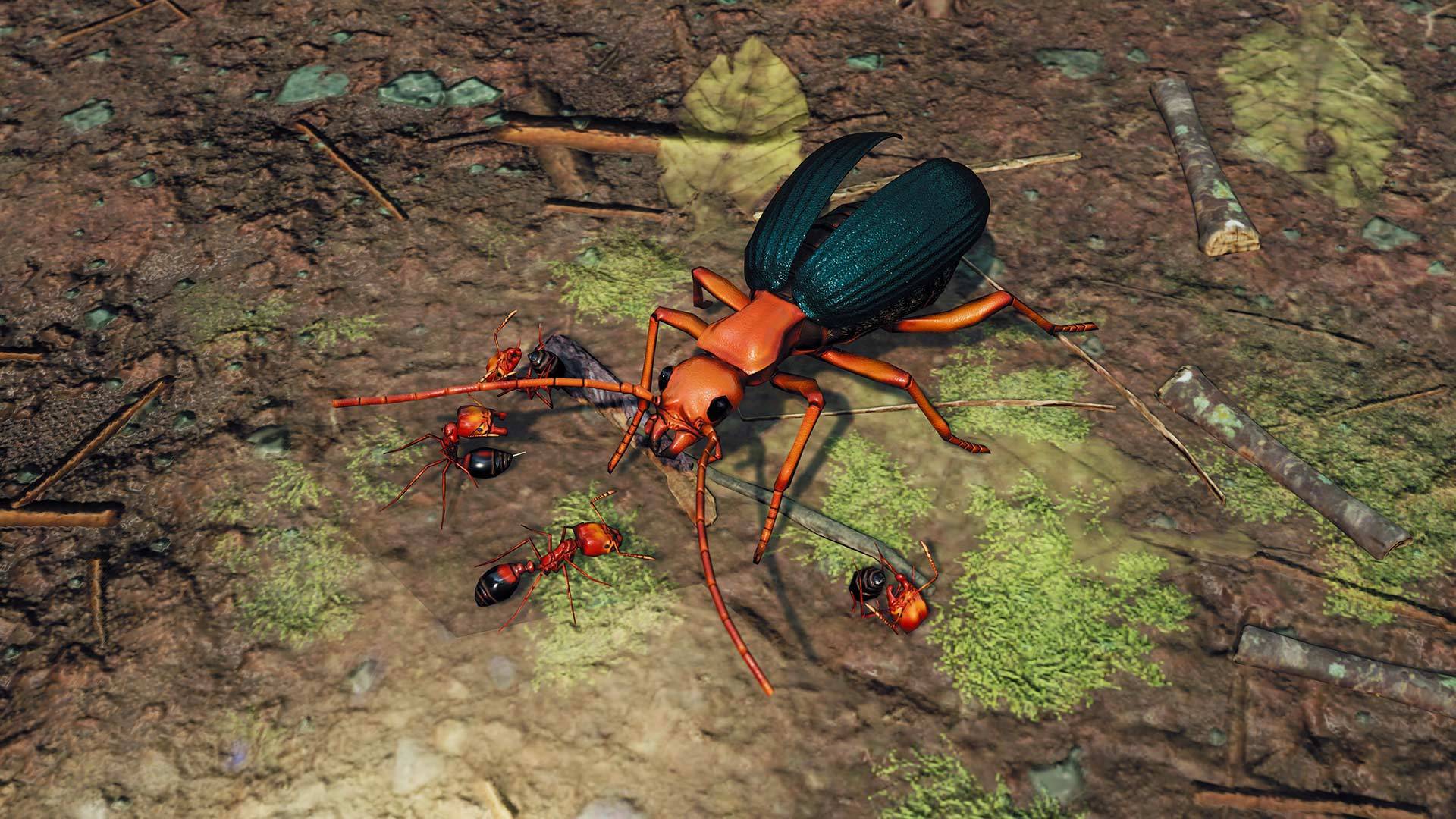 A bombardier beetle faces off against fire ants
By mixing various chemicals and enzymes together in a special internal chamber, the beetle produces a violently exothermic reaction. The resultant mixture reaches close to the boiling point of water and is expelled by the rapid rise in pressure through an opening pointed at the beetle’s enemy.
 Near-boiling liquid is explosively fired at the beetle’s enemies
If you’re a large vertebrate predator, this irritant is likely to be enough to put you off having a bombardier beetle for dinner. If you’re the size of an insect, however, the momentary boiling temperature of this liquid can easily be fatal. With the large area of effect this defensive spray has, it’d be wise to consider carefully whether the bombardier beetle is worth the inevitable casualties.
Mimicry is seen everywhere in the animal kingdom – creatures evolve to look like more dangerous ones, which gives them a deceptive advantage. The false bombardier beetle (Galerita bicolor) has evolved to look almost identical to its namesake, with some minor differences in colouration and morphology.
 An impostor among us – a false bombardier beetle looking sus
This helps it avoid predation, but the false bombardier beetle is not without defences – it’s significantly larger than the true bombardier, has the same chitinous armour, and uses muscle action to spray a solution that is mainly made of a familiar substance – formic acid.
 Size comparison to the false bombardier (left) and the true bombardier
Whilst not as deadly as the boiling liquid that is explosively fired by the true bombardier, formic acid will still do considerable damage to small creatures. It’s the same acid used by the ranged wood ants of the 2nd tier, and it’ll have a similar in-game consequences – an area of effect venom-type attack.
Cleridae – the checkered beetles – are distributed worldwide. This particular species is called Enoclerus rosmarus, and it’s a common sight in North America. They’re active hunters, and their preferred habitats are moist and sunny – qualities which will bring them into conflict with your fire ants.
 A checkered beetle minding its own business
Checkered beetle larvae are also hunters, which in Empires of the Undergrowth will give them a similar role to rove beetle larvae in previous levels. They’re more vulnerable in this state, before they develop the chitinous armour they have as adults – but they’re still a force to be reckoned with.
 Checkered beetle larva fights fire ants
At the moment, the various AI colonies we have in the game are either heavily scripted (as in 2.2) or reliant on preset “points of interest” which they use to decide where to send their forces (3.1, freeplay). This makes them relatively robust but doesn’t allow them to make very complex decisions on a changing battlefield. Liam has been working on a scanning solution that will let colonies periodically scan the surface for interesting things, giving them the ability to make much more relevant choices.
Green squares represent areas of interest the AI scan has found
These will be used on all of the remaining campaign levels, all of which will feature AI colonies in some form. Eventually, we hope to transplant this feature to freeplay too – after fire ants, we are likely to do another big round of freeplay changes to bring that game mode closer to its release form.
Two colonies scan for points of interest on one another – light orange is the real scan, the maroon is a skipped scan where it decided to use saved data from a scan not so long ago in the same place
I’m sure many of you are familiar with the fan wikis that crop up; fandom.com is one of the more prominent ones. We’ve been slightly bemused by these and not entirely sure what to make of them – up until very recently, they were simply placeholders with very little in the way of articles. However, thanks to some dedicated community members, the Empires of the Undergrowth fandom.com wiki [empires-of-the-undergrowth.fandom.com] has had some big content additions over the past couple of months.
Particular thanks to thanhmk28 on our forums for putting a lot of time into the fandom wiki, and writing / formatting a majority of the articles so far. On it you’ll see creature stats and abilities (taken from a version of the spreadsheets that the game uses that we host on our website) that might well be useful for people looking for a more solid idea of what various creature’s strengths and weaknesses are until we implement a way to see these in the game.
 [empires-of-the-undergrowth.fandom.com] The EotU Fandom Wiki
For final release, there will be plenty of information accessible in-game with our own encyclopedia system. Even after that’s implemented, there will always be a place for community-driven wikis like these – they’re definitely an appropriate place to post guides, creative strategies and suchlike that won’t be in the game itself.
A couple of months ago, Tom Johnson released his evolution simulation game Ecosystem into early access on Steam. Slug Disco are the publishers for it, and it’s been a joy to see how it’s been received and how community feedback is already shaping the direction Tom has decided to push things.
About once fortnightly, Tom has been sharing his progress and direction with us and we’ve been posting these as articles on the game’s Steam page. He’s now at a point where he can share the path he’s chosen for Ecosystem’s first major update, which will focus on graphs and analytical tools so the player can see plant, predator and prey relationships in much greater detail than before.
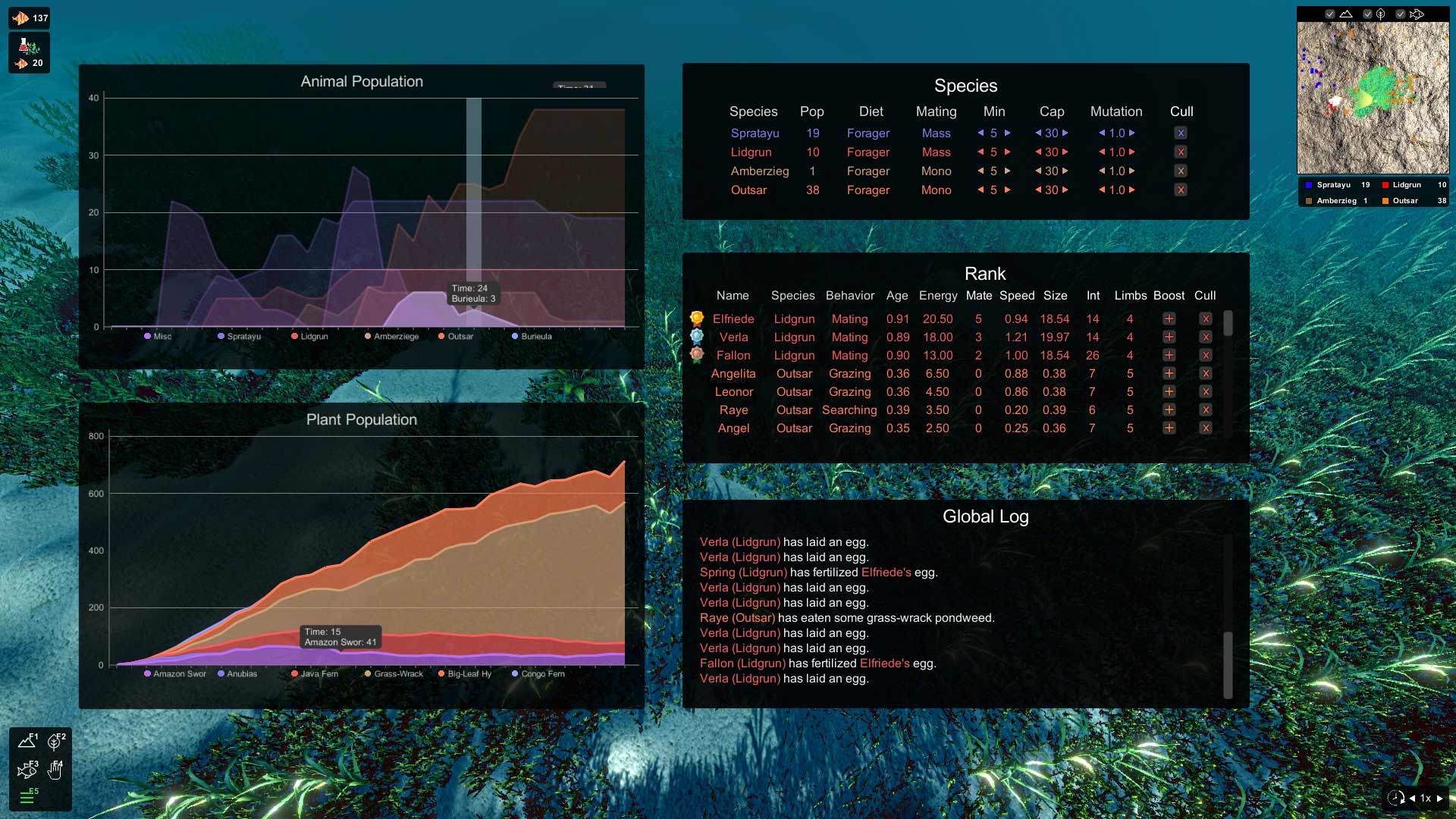 The graphs and analytical tools coming soon to Ecosystem
Ecosystem continues to progress rapidly as a project and if you have an interest in speculative evolutionary biology, serene aquatic environments, or even just producing abominations such as human-like fish then we heartily recommend giving Ecosystem a spin. It has a demo which shows a lot of the basic features, but the full thing is gearing up to be something altogether more special.
Seriously, I feel like this section is just for me – every time I write a newsletter, I look forward to the bit where I have a browse through some recent screenshots posted to our Discord [discord.com] or uploaded to the community, and select three of my favourites. If you’d like to participate, by far the easiest way to get your screenshot to us these days is Discord. You can also email them directly to mike@slugdisco.com.
 A pleasing formicarium from BrickyGraph631
 Trapjaws under attack from a hidden jumping spider from Rarity
 A close call in extra level Excavators from Crazlex9