
Minecraft Forums
Groupmanager/Permissions not working right. «You are not permitted to use, interact. ston_plate, dirt..etc»

Hello i have just recently created my server and i have been doing fine until now. I was getting prepared to begin allowing users to enter the server, when i encountered this problem.
«You are not permitted to use, interact. «. It seems when i de op, i can not touch or do anything. (when i am op, i can) This is a problem. i would like to permit new user or just the guest group to follow their set permissions..Ideally i would like all groups to work right.
The code for the GroupManager config.yml file is:
world:
world_nether:
— users
— groups
world_the_end:
— users
— groups
all_unnamed_worlds:
— users
— groups
guest:
guest:
— users
Additionally, there are four separate folders within «/groupmanager/worlds/guest, mainland (my main world), world, all_unnamed_worlds
The code for «groups.yml» located inside Groupmanager/worlds/guest is:
# Group inheritance
#
# Any inherited groups prefixed with a g: are global groups
# and are inherited from the GlobalGroups.yml.
#
# Groups without the g: prefix are groups local to this world
# and are defined in the this groups.yml file.
#
# Local group inheritances define your promotion tree when using ‘manpromote/mandemote’
groups:
guest:
default: true
Permissions:
— randomtp.portal*
— essentials.build*
— essentials.help
— essentials.kits.guest
— essentials.build.interact.
Info:
build: true
prefix: ‘[Guest]’
I have set build to true, and gave the permission node to build and interact, yet in the game it seems these permissions are not working. However, i would like to add that the code must not be all wrong becuase the prefix ‘[guest]’ does appear in the game for the guest group.
Saving changes is not permitted error message in SSMS
This article helps you work around the problem in which you receive an error message when you try to save a table in SQL Server Management Studio (SSMS).
Original product version: В SQL Server
Original KB number: В 956176
Symptoms
When you try to save a table after making changes to the table using Designer in SQL Server management Studio, you may receive the following error message:
Saving changes is not permitted. The changes that you have made require the following tables to be dropped and re-created. You have either made changes to a table that can’t be re-created or enabled the option Prevent saving changes that require the table to be re-created.
This problem occurs when you make one or more of the following changes to the table:
Cause
This problem occurs because the Prevent saving changes that require the table re-creation  option is enabled by default in SQL Server Management Studio.
When you change a table so that you alter the metadata structure of the table, and then you save the table, the table must be re-created based on these changes. This may result in the loss of metadata and in a direct loss of data during the re-creation of the table. If you enable the Prevent saving changes that require the table re-creation option in the Designer section of the SQL Server Management Studio (SSMS) Options window, you receive the error message that is mentioned in the ‘Symptoms’ section.
Workaround
To work around this problem, use ALTER TABLE Transact-SQL statements to make the changes to the metadata structure of a table.
For example, to change MyDate column of type datetime in at table called MyTable to accept NULL values you can use:
We strongly recommend that you do not work around this problem by turning off the Prevent saving changes that require table re-creation option. For more information about the risks of turning off this option, see the ‘More information’ section.
More information
To change the Prevent saving changes that require the table re-creation option, follow these steps:
Open SQL Server Management Studio.
On the Tools menu, click Options.
In the navigation pane of the Options window, click Designers.
Select or clear the Prevent saving changes that require the table re-creation check box, and then click OK.
If you disable this option, you are not warned when you save the table that the changes that you made have changed the metadata structure of the table. In this case, data loss may occur when you save the table.
Risk of turning off the «Prevent saving changes that require table re-creation» option
Although turning off this option can help you avoid re-creating a table, it can also lead to changes being lost. For example, suppose that you enable the Change Tracking feature in SQL Server to track changes to the table. When you perform an operation that causes the table to be re-created, you receive the error message that is mentioned in the Symptoms section. However, if you turn off this option, the existing change tracking information is deleted when the table is re-created. Therefore, we recommend that you do not work around this problem by turning off the option.
To determine whether the Change Tracking feature is enabled for a table, follow these steps:
When the Change Tracking feature is enabled, use Transact-SQL statements to change the metadata structure of the table.
facebook authentication error – you are not permitted to do that
Scenario:
I was wandering around facebook today and while doing random stuff i saw this error on facebook saying:
Authentication Failure
You are not permitted to do that.
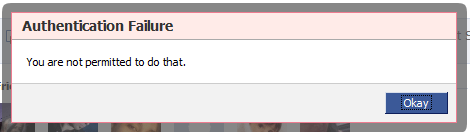
Well i got this loss of permission and error of authentication failure by facebook in this situation:
I was logged into facebook with my email id. I was surfing through it and checked one of the profiles (it was not already in my friends list). I liked to add that person, but not in this id, but my other one. So i opened facebook on new tab/page and logged off facebook on that other page and logged in with my other facebook id. Why i did it in new page? well if you do so then you probably know why 😉 because i wanted to keep that person’s profile page open! ofcourse!
Now when i went back to the person’s facebook profile tab and clicked Add as friend, It gave me authentication error, saying that you are not permitted to do this. And well it was pretty simply to solve it too!
Solution:
Well, so obviously! the solution was simple enough! simply refresh that persons profile page, it will reload the same page again. Now when you try to add that person to your facebook profile, it will not give you the error. It probably gave the error because your cookies were not the same as the current account. That’s why facebook gave the authentication failure error and told you that you are not permissted to do that action.
If you got this error on facebook while doing some thing different and solved it in different way, please let me know in the comments below.
Fix Terminal “Operation not permitted” Error in macOS Big Sur, Catalina, Mojave

If you’re a Mac command line user you may have noticed that many frequently used commands entered into the Terminal (or iTerm) result in an “Operation not permitted” error message since updating to MacOS Mojave 10.14 or later. The “Operation not permitted” error in the Terminal can be seen after issuing even simple commands like using ‘ls’ ‘mv’ and ‘cp’ within the users own directory, but also in many other directory locations on the Mac, and when trying to use many defaults commands. Obviously this type of error message makes navigating and using the command line in MacOS Mojave to be quite difficult if not impossible for many purposes. Don’t worry, the Terminal is not broken in new MacOS versions.
This walkthrough will show you how to fix “Operation not permitted” error messages seen at the command line in Terminal for Mac OS in Mojave 10.14 or later.
How to Fix “Operation not permitted” Error in Terminal for Mac OS
If you have not encountered the “Operation not permitted” error message in the Terminal of MacOS (Mojave 10.14 or later) yet, then it’s likely because you haven’t wandered into a directory or file path that has the additional access restrictions (or that you don’t use Terminal, in which case this entire article is not for you).
While many of the various core System and root directories will throw error messages in macOS Terminal too, you can also find the error message even when trying to work in the users own Home directory, including in many of the user
/Library/ folders, like
/Library/Messages (where iMessage attachments and chat logs are stored in Mac OS) and
/Library/Mail/ (where user-level mail plugins, mailbox data, and other Mail app data is stored), and many others.
You can test this yourself, before and after making the settings adjustment outlined above with a simple command like using ls on one of the protected folders:
If Terminal does not have Full Disk Access granted, you will see the “Operation not permitted” error message.
If Terminal does have Full Disk Access granted, or if SIP is disabled, you will not see that error message in the MacOS Terminal.
In case you were wondering, yes that does mean there are actually two ways to fix the “Operation not permitted” errors you may encounter in MacOS Terminal; the first which we detail here is rather simple that grants additional access privileges to Terminal app, and the other is a bit more dramatic which involves disabling System Integrity Protection on the Mac which is generally not recommended and we won’t specifically cover here, though simply disabling SIP and rebooting is typically enough to make the error go away if you’d rather go that route.
The “Operation not permitted” message is one of a variety of command line errors you may encounter in Mac OS Terminal. Another frequently seen command line error is the the “command not found” error message which can also be encountered in the Terminal for MacOS for a variety of different reasons as well.
If you have any other tips, tricks, suggestions, or thoughts about the command line in MacOS or this particular error message, share with us in the comments below.
Related
Enjoy this tip? Subscribe to our newsletter!
Get more of our great Apple tips, tricks, and important news delivered to your inbox with the OSXDaily newsletter.
Thank you!
You have successfully joined our subscriber list.
Related articles:
58 Comments
I found that virtual box running ubuntu could do stuff sroot on terminial on macos could not WTF.
But that does mean I have a separate spot to go whenever there is a problem without having to open terminal up for ALL users ( IE me when am just mis-typing)
This works like charm!
Thank you
A million thanks worked perfectly.
work like a charm, thanks for safe my days
Thanks, hint about how to give Terminal full disk access saved my day
Remember when Apple’s slogan was “it just works”? That was nice.
thx a lot
I had to give permission to the terminal in order to use a dd command to clone a HDD drive
that’s really helpful, thanks very much!
This fixed my problem under macOS 11.2.2. Until now, I never encountered such a problem. Thanks.
Still impossible to issue rm commands
Thank you so much. Helped fix my error related to XCode not recognizing my modules and not being able to open one of the files associated to the modules. Much thanks!
Just fixed this problem for the following scenario in Catalina. I have a backup script that runs from /etc/daily.local and therefore needs full disk access. The /etc/
Figured that out by having daily.local run a program called “treeps.pl” that puts out a tree-oriented process list. From that, you can work back up the tree to see who ran “daily.local”. You can find treeps.pl here: https://apple.stackexchange.com/questions/11770/linux-ps-f-tree-view-equivalent-on-osx (search for “treeps”, not “pstree”).
I hope I stuffed enough good keywords in there to save someone the time it took me to track that down!
This may be helpful if you are trying to replicate the tree command on Mac too:
I upgraded an unsupported machine (MacPro 4,1) to Mojave using the DosDude1.com patch, and now my numerous Ruby scripts won’t work.
That didn’t help, so I change all my scripts to refer to the Homebrew version, by making “#!/usr/local/opt/ruby/bin/ruby” the first line. Still no joy.
When trying to run any ruby script, I get:
/usr/local/opt/ruby/bin/ruby: bad interpreter: Operation not permitted
However, strangely enough, I CAN do “/usr/local/opt/ruby/bin/ruby Charmaine says:
this worked for me! thank you so much!
Bonjour j’ai un soucis avec mon terminal je suis mac os Hugh sierra 10.13.6 je voudrais faire reconnaitre ma carte USB wifi a partir de mon terminal avec cette instruction sudo /Applications/TextEdit.app/Contents/MacOS/TextEdit /System/Library/Extensions/RT2870USBWirelessDriver.kext/Contents/Info.plist demandant mon mot de passe administrateur après mon mot de passe il écrit Illégal instruction:4 que faire
Just like Jeff and Marius before me I couldn’t get rid of the ‘Operation not permitted’ error despite following these instructions.
Is there anything else I can try?
What worked for me at the end was to add “/bin/bash” to the list of Full Disk Access. (After hitting “+” in Step 5 above, hold “Cmd-Shift-G” and type “/bin”, then click on “bash”.)
I have seen the posts about “how to add users to the sudoers list”, but if I have no sudoers, I can’t execute any SUDO commands. Ho can I add a sudoer without using terminal “sudo” command.
Thanks Paul, Terminal in OSX is working now, but when SSH to mac it still says Operation Not Permitted when listing some directories.
Tried adding /bin/ssh and sbin/sshd if I remember correctly still same problem. Any clues? Thanks!
Thank you for this tip, was very helpful and easy. I ran in to this issue after updating to Catalina and it helped me.
I was getting below error and it is fixed now.
Thanks so much for posting this and making it very easy to understand, it helped fix my problem on my own Mac, as well as my mom’s MacBook. It’s so great to have forms like this to help fix problems that Apple has made.
Glad this could help you resolve your issue with “Operation not permitted” errors in MacOS, thanks for reading! This applies to Catalina too.
Gracias, i was facing the issue after i upgraded to Mac OS Catalina, and ur fix worked for me.
Thanks for publishing the solution. It solved my problem.
I can confirm what Jeff said. After adding Terminal to the Full Disk Access List, and restarting it (even rebooting), I still see:
$ cd /usr
myprompt:/usr$ sudo chown myuser:staff local/
Password:
chown: local/: Operation not permitted
myprompt:/usr$
This doesn’t appear to work for certain files or folders. After giving full disk access to Terminal, as described, and restarting Terminal:
jeffsidell$ cd /usr/bin
Jeffs-MacBook-Pro-2:bin jeffsidell$ sudo mv python python2.7.10_JPS_mv_python
Password:
mv: rename python to python2.7.10_JPS_mv_python: Operation not permitted
I do NOT want to give terminal full disk access for ALL users. I want to give terminal full disk access ONLY for root. Is there a way to do that?
Thanks budy, this really solved my terminal issues with “Operation not Permitted”.
I did the first few steps but I can’t find the Full Disk Access option. Help
Same here can’t find the Full Disk Access. Help us 🙁
Couldn’t also find the Full Disk Access.
First you could try emptying the trash securely. [Finder->Secure Empty Trash…].
If that doesn’t work, go to the terminal and navigate to the trash folder. It will probably be in [/Users/your_user_name/.Trash].
If that doesn’t work, you will have to disable SIP (System Integrity Protection)
I had the same problem. Like stargood said, you probably have to disable SIP (see link in this article). This should let you delete the files.
Don’t forget to turn it on afterwards, if you don’t explicitly need it off.
For anyone writing a shell script that’s run by `cron`, e.g. you use `rsync` in a script to backup your files on another server…
You will notice that adding “Terminal.app” to the “Full Disk Access” does not work, because cron does not use “Terminal.app”.
Now you could grant “Full Disk Access” access to the `rsync` program, and that solves some of the permission problems, but this is not enough if you need access to:
Instead, you should add `cron` to “System Preferences > Security & Privacy > Full Disk Access”.
I did this by running `open /usr/bin/`, which opened a Finder window that allowed me to easily drag/drop the `cron` program into the “Full Disk Access” list.
After one year your post saved my scripts life 😉
After 1.5 years, this helped resolve my issue as well. Thanks.
If you expect “security” and “privacy” in a closed source operating system, you’re a lost cause anyways. If you aren’t even allowed to understand how your online banking balance was being rendered on your screen, you should overthink your ways. Remember: If the number on your online banking page is all wrong, you’re going to starve. So this isn’t some “minor thing only nerds should care about”.
Security in Mac OS X. Pff.
These new “security” features and alerts of 10.14 are nothing more than annoying and unnecessary tactics to trick fools into believing they’re safe. Apple calls these things “features”, but for skilled administrators those are nothing more than “bugs”, simply put. Because they break stuff. Render it unusable, unless intervened.
After having migrated from an earlier macOS/Mac OS X release to 10.14, you’ll find your Macintoshes automation techniques struggling hard. In order to get your deserted Mac up and running again, I suggest the following:
Doesn’t fix every annoyance, as it won’t mute alerts that will pop up from applications and executables you’ll install in the future, but it is a step forward.
And please don’t give me crap about how I lure users into doing “dangerous” things. Keep your security hysteria to yourself. If Mac OS X managed to strive without a malware epidemic from 2001 until now, it will continue to do so, even if you enable the “evil evil” disk access.
I’m critically fed up with Apple in 2018. We’re reaching idiocy and greed levels that shouldn’t be possible.
Rather than complaining and moaning, why don’t you simply disable System Integrity Protection? It takes like two minutes, tops. *eyeroll*